How to Protect Your Music from AI: A Complete Guide for Artists
Quick Answer
To protect your music from AI training, combine three layers: register your work on opt-out platforms, apply adversarial perturbation to your audio files before release, and maintain documented copyright records. Of these, adversarial perturbation is the only method that disrupts AI models from learning from your music without depending on AI companies to voluntarily comply.
Key Takeaways
- Over 100,000 songs are released daily, and more than 2,400 audio AI models are actively training on music scraped from the open web.
- Legal protections are slow and reactive. Even if you win a lawsuit, the model trained on your work is already trained — you cannot un-teach it.
- Adversarial perturbation is the strongest current defense. It adds inaudible changes to your audio that disrupt AI training without affecting how the track sounds to listeners.
- A layered approach works best. Combine opt-out registrations, technical protection, and legal documentation rather than relying on any single method.
How Does AI Actually Train on Music?
AI music models learn from your tracks by analyzing patterns in your audio. Rather than storing copies of your songs, they extract the relationships between melody, vocal phrasing, and style across millions of examples.
That learned representation is what lets a generative model produce a new track "in the style of" any artist whose music it ingested. Your specific song isn't quoted in the output. Your sound is.
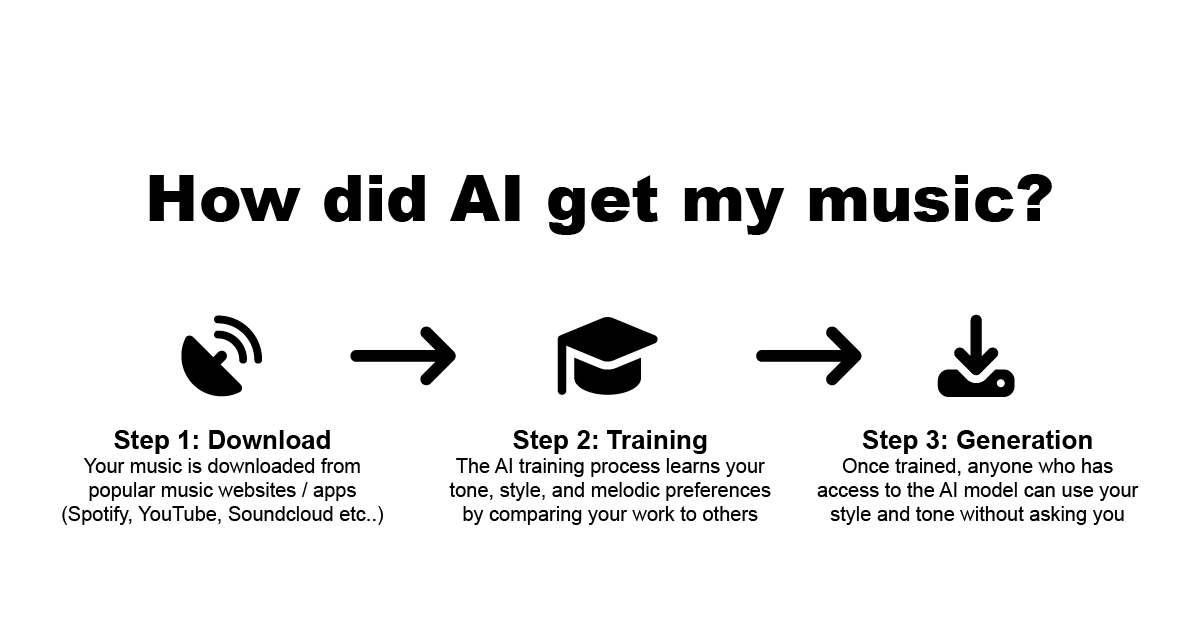
Where AI companies get music data
Most generative music models train on three sources:
- Publicly accessible audio scraped from streaming platforms, YouTube, SoundCloud, and the open web.
- Leaked or grey-market datasets passed around in research circles.
- Licensed catalog deals struck with major rights holders. The licensed deals make the news. The scraping is what most artists never hear about. If your music is streamable or downloadable anywhere on the internet, it's reachable by a scraper.
How is AI training different from sampling?
Sampling has a settled legal framework: clear it, pay for it, or take the legal risk. AI training sits in a different category entirely.
The model doesn't copy a recognizable chunk of your track. It learns patterns — which means traditional sampling law doesn't cleanly apply. That gap is where AI companies have been operating for years.
Why Should Artists Care About AI Training?
The consequences go well beyond principle. They affect revenue, identity, and the long-term value of your catalog.
More than 50 music generation websites are now publicly available, with new ones launching monthly. Every one of them needs training data, and they get it from artists like you.
How AI steals from artists
- Streaming revenue. AI-generated tracks compete with yours on the same platforms. Plays that go to synthetic music in your style don't go to you.
- Voice and likeness. A short sample of clean vocals is enough to clone a singer's voice. That clone can appear on tracks the original artist never approved.
- Catalog value. Labels and rights holders are noticing: catalogs whose stylistic DNA is already absorbed into freely available AI models are structurally worth less than catalogs that aren't.
- Irreversibility. This is the consequence most artists don't grasp until too late. A model that trained on your work is already trained. No verdict, settlement, or regulation can pull your music back out of its weights.
"The industry has been waiting for a solution like this. It's exciting to see this tackling AI misuse head-on." — Trilago, Warner Music Artist / Producer
What Are Your Legal Rights Against AI Music Training?
Your legal options exist, but they're slow, expensive, and reactive. Courts are still defining the rules, and AI training continues while they do.
Is it legal for AI companies to train on copyrighted music?
The honest answer: it's unsettled. AI companies argue training is a transformative fair use. Rights holders argue it's unauthorized reproduction at industrial scale.
Major cases are working through US courts now, and outcomes will likely vary by jurisdiction. In the meantime, scraping continues whether or not it's ultimately ruled legal.
Major lawsuits shaping the landscape
- RIAA v. Suno and RIAA v. Udio (2024): The Recording Industry Association of America sued both AI music companies, alleging they built their models by scraping copyrighted recordings at scale.
- Universal, Concord, ABKCO v. Anthropic: Major publishers sued over the unauthorized use of song lyrics in training data.
- New York Times v. OpenAI: Not a music case, but its outcome will influence how training-data claims are treated across all media.
What about opt-out registries?
Registries like Spawning's "Have I Been Trained" let you flag your work as off-limits for AI training. They are useful, but they only work if AI companies voluntarily honor them.
The companies most likely to respect an opt-out are the ones least likely to scrape you without permission in the first place. The bad actors keep scraping.
Where is regulation heading?
The EU AI Act introduced disclosure requirements for training data and stronger opt-out mechanisms. The UK is consulting on its own framework. US regulation remains fragmented and slow.
For the next several years, artists will live in a legal patchwork where what's prohibited in one country is openly practiced in another.
What Are the Best Ways to Protect Your Music from AI?
Six methods are available today. Most artists should use a layered combination of them, not just one.
Comparison of music protection methods
| Method | What it does | Prevents AI training? | Cost | Effort |
|---|---|---|---|---|
| Opt-out registries | Flags your work as off-limits | Only if AI co. complies | Free | Low |
| Platform-level policies | Restricts training within a platform | Partial, inconsistent | Free | Low |
| Audio watermarking | Proves ownership after the fact | No (forensic only) | Low | Low |
| Adversarial perturbation | Corrupts AI's ability to learn from audio | Yes, at file level | Low | Low |
| Copyright registration | Establishes legal standing | No (legal only) | Low | Low |
| DRM-style restrictions | Limits playback | No | Variable | High |
How do you prevent AI from using your music?
Adversarial perturbation is the technique that confuses any AI attempting to steal your protected music. This technique confuses AI without disrupting the listening experience.
Your protected song sounds the same to you, your fans, and your A&R. It just doesn't sound the same to an AI trying to learn from it.
This is the science behind Protect My Sound. Our approach is built on research published by the University of Tennessee, Knoxville and Lehigh University — HarmonyCloak: Making Music Unlearnable for Generative AI — which mathematically demonstrates how adversarial perturbation can make a protected track effectively unlearnable for generative AI models while preserving audio quality.
The technique has a broader research lineage. Glaze and Nightshade apply the same principle to protect visual artists from image-generation AI. We apply it to audio.
What about DRM and AI-detection tools?
Be wary of approaches that sound protective but aren't:
- DRM-style restrictions degrade listener experience and don't stop AI training. They cost you fans.
- AI-detection tools flag synthetic audio but don't protect your own work from being scraped.
- Vague terms-of-service updates in your release notes have essentially zero legal weight against a third-party scraper.
"This is awesome! Excited to be able to drop tracks and not have some AI rip my sound." — Joel Freck, Armada Music Artist / Producer
What Should You Do Right Now? A Practical Action Plan
Here is the order to work through, starting today.
1. Register on opt-out platforms this week
Sign up for Have I Been Trained, Spawning, and any opt-out systems your distributor offers. This is free, takes minutes, and puts your music on public record as protected.
2. Audit your distribution agreements
Read the AI and machine-learning clauses in every platform and distributor contract you've signed. Some platforms quietly reserve the right to license your work to AI companies. Know what you've already agreed to.
3. Apply our protection to your masters before they can be stolen
This is the layer that works without depending on anyone else's good behavior. Prevent AI from using your music with Protect My Sound — you can try it with a 24-hour free trial when you add a payment method.
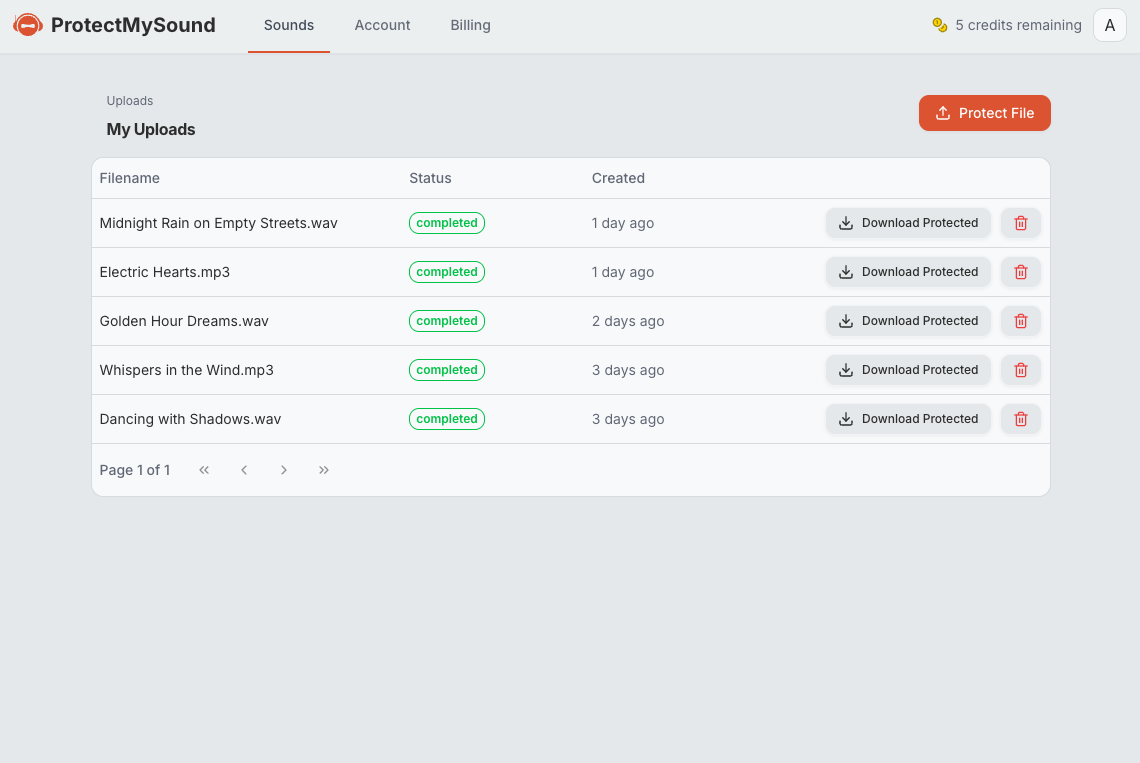 Protecting a track is drag-and-drop. No software installs, no audio engineering knowledge required.
4. Document your catalog
Keep timestamped records of your masters, registrations, and release dates. If you ever need to pursue legal action, this is the foundation everything else builds on.
5. Stay informed
AI lawsuits, regulations, and industry policies are evolving fast. Subscribe to one or two music-industry newsletters that cover the AI beat.
6. For labels: protect at the pipeline level
Bring protection into your release workflow so it's not a per-track decision. We work with rights holders on catalog-level integration. Reach out if that fits your operation.
Frequently Asked Questions
Can AI companies legally use my music without permission?
The legal status is unsettled. AI companies argue training is fair use; rights holders argue it's unauthorized reproduction at scale. Major cases are working through the courts now and will define the rules over the next several years.
How do I know if my music has been used to train AI?
Usually, you don't. Most training datasets are not public, and AI companies are not required to disclose what they trained on. Some opt-out registries offer partial visibility into known datasets, but proving your specific track was used is currently very difficult.
Does Spotify protect my music from AI training?
Partially and inconsistently. Platform policies have been tightening but vary in enforcement. Distributing through any major platform does not, on its own, protect you from third-party scraping.
Can AI clone my voice from a single song?
Yes, often. Modern voice cloning models can produce convincing imitations from a few minutes of clean vocal audio. Some require less than that. Singers and vocalists are among the most exposed artists in the current landscape.
What is adversarial perturbation?
Adversarial perturbation is a technique that adds inaudible changes to audio designed to disrupt AI training. The changes target the mathematical patterns AI models rely on, making the protected track effectively unlearnable for those models while sounding identical to human listeners.
Will protecting my music change how it sounds?
No. The whole point of adversarial perturbation is that the changes are inaudible to human listeners. Your track sounds the same to your fans, in your DAW, and on every platform.
Is there a free way to protect my music from AI?
You can register opt-outs for free, which provides limited protection. Active technical protection like Protect My Sound is a paid product, but a 24-hour free trial is available when you add a payment method, so you can protect tracks and verify the result before committing.
How is AI protection different from copyright registration?
Copyright registration establishes your legal ownership and is essential for pursuing infringement claims. It does not, on its own, prevent your music from being scraped or used in training. The two work together: copyright protects your rights, adversarial protection disrupts the technical act of training.
How long does it take to protect a song?
With Protect My Sound, protecting a single track takes under a minute. Upload, process, download. No software installs, no audio engineering knowledge required.
Does protection work on any audio format?
Yes. Protected files are compatible with all major streaming platforms including Spotify, Apple Music, YouTube, and SoundCloud. Standard formats — WAV, MP3, FLAC — are all supported.
A Final Word
The fight over AI and music will not be settled by one court ruling or one piece of legislation. It will be settled the way these things always are: a mix of regulation, lawsuits, market norms, and artists who refuse to accept that consent is optional.
Protect My Sound was built by E-Flex Digital, an award-winning Los Angeles digital studio, because we believe artists should get to decide whether their music trains a generative model. Not AI companies. Not platforms. Not lawyers a decade after the fact. The artists who made the work.
If your music is worth listening to, it's worth protecting. Start your free 24-hour trial and protect your first track in under a minute.
This guide is updated as the legal and technical landscape evolves. Last updated: June 2026. This guide is not legal advice. It is a general overview of the legal and technical landscape. It is not a substitute for legal advice.